How I Teach the Newbery Medal Awards

January has arrived, winter break is almost over, and planning for a new year has begun. The Newbery Awards is one of my favorite lessons to do in January, second only to Mock Caldecott, but just as worthy of some recognition. I feel it is a valuable lesson that exposes students to past winners and hopefully gets them reading some of these great books that are hiding on the shelves. There are reasons why the books on this list have won and exposing students to good literature is a key part of our job. Adding this unit has been a great way to keep students engaged and learning about NEW and OLD books in my library.

What is the Newbery Medal Award?

The Newbery Medal is an annual award given by the American Library Association to the author of the most distinguished children’s book published in the previous year. The winner is announced at the end of January at the same time Caldecott and other literature awards are announced. The Newbery Medal winner is chosen by a committee of 15 people. The winning author receives a bronze medal and may have a metallic seal of the medal added to future printings of their book. In addition to the medal winner, one or more honor books are also chosen each year. 

Each year I start my unit by doing a Google Slides presentation to teach students about the Newbery Medal. Even though students may hear the lesson a couple times they are still learning as the information is lost over the year and reteaching is always a good idea. After the lesson slides we read the book Balderdash!: John Newbery and the Boisterous Birth of Children’s Books by Michelle Markel. This book gives some great background on John Newbery.

Finding Newbery Winners in Your Collection

Most of us have or should have many of the Newbery Award winners and Honor winners in our collections. This is a great time to bring them to the attention of students and get them circulating again. I like this lesson because it does stimulate circulation of good books that may have been forgotten. The lesson I use is a scavenger hunt that sends students into the stacks looking for the Newbery winners. Not only will they be looking at books to possibly check out later but they are also practicing finding books within my library. That is a win win in my book.

To add to this lesson and give them more to do than simply find the books and write the call numbers. While they are doing the scavenger hunt they will also need to make book recommendations. I usually have them do 2 recommendations from all the books they will search. This is just short form they fill out with title, number of pages, and brief synopsis.

What if I Don’t Have the Book?

When using the Newbery winner and the Honor Medal list there may be a number of books you don’t have in your library. I also don’t have all of them but this leads to a great opportunity for students to use Destiny….or whatever system your library uses…to look up the books. They can then see if the book is available in the library or if it might just be checked out by someone else. If it is not available I have them put an X on the box. If it is in our library but checked out I have them put a check mark on the box. I have found this to be a great way to get students using the library system to look for books and then later they can use that skill to find books they are wanting to read.

Wrapping Up the Lesson

This lesson may take more than one library class to complete. I have them work with a partner and that does help speed up the process as one can be the person who reads the call number while the other is writing it down. Same with the recommendation form, one can read the synopsis out loud and both can decide how to summarize it. Once they have completed the scavenger hunt and the recommendations I give them an exit ticket which is a half sheet that the fill out with the titles of 3 Newbery Award books they think they would like to check out in the future. I feel this adds to the lesson because students are picking up the books, reading the synopsis, and then deciding if it might be one they would like to read in the future.

I believe this is a great lesson for getting students out looking through your collection, finding Award winners, evaluating them, and maybe even reading some of them.

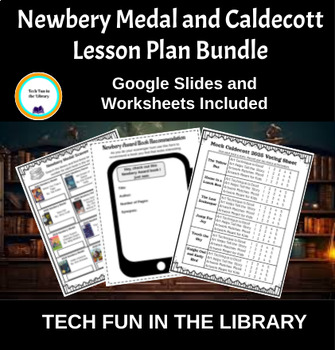
Shop for your Newbery Medal Award Unit Lesson Plan here.

Shop for your Caldecott and Newbery Unit Lesson Plan Bundle here.

Grab your your FREE Coretta Scott King Awards Google Slides Presentation here.

Why Having a Diverse Collection Matters

 In an increasingly diverse world, one of the most important responsibilities of libraries is to make sure our collections reflect a wide range of voices, experiences, and perspectives. A diverse collection in a library is not merely a matter of quantity—it’s about ensuring that everyone can see themselves represented in the materials we have in our libraries. The content in libraries should reflect the richness of human experience, addressing issues of race, gender, class, sexuality, ability, and beyond. Here’s why a diverse collection is so important:

Promoting Inclusivity and Representation

Representation matters. When libraries feature diverse materials, they validate the experiences of all groups. This is especially crucial for young readers and members of underrepresented communities who might not see themselves reflected often in books. Diverse collections ensure that every patron, regardless of background, can find books that connect with their identity, experiences, and struggles.

For example, children who see characters from various cultures, backgrounds, and abilities in books are more likely to develop empathy and an understanding of people who are different from themselves.

Encouraging Critical Thinking and Empathy

Our library collections should serve as a mirror to the world. Having library materials that present different viewpoints, backgrounds, and beliefs, will help encourage students to think critically about the world around them. Exposing students to diverse perspectives helps them to develop a deeper understanding of the world and people around them.

Fostering a Sense of Belonging

Libraries should be safe spaces where students can explore new ideas, learn, or even just find comfort in a place they feel safe and seen. When library collections are diverse, they create an environment where everyone feels seen and heard. For members of underrepresented communities, knowing that the library acknowledges their histories, experiences, and identities fosters a sense of belonging and respect.

These are just a few of the reasons we should be making sure that our collections are diverse to meet the needs of all our students. It is never too early to get started on making your collection as diverse as possible. A diverse library collection is not just about offering more books—it’s about building a more inclusive, understanding, and just world for everyone.

Book Shelving…Who Has the Time?

Here we are almost half way through the current school year and book returns are on the rise. While this is great it does pose a problem….shelving. One of the big issues I hear from school librarians is that there is very little time to shelve books. What do you do about book returns? How do you get them back on the shelves in a timely manner? As a librarian of a K-12 library with no aide, I understand the difficulties of shelving books while conducting back to back classes. I have made a few adjustments in my library to make it easier to go home with an empty book cart every day.

Baskets for Series Books

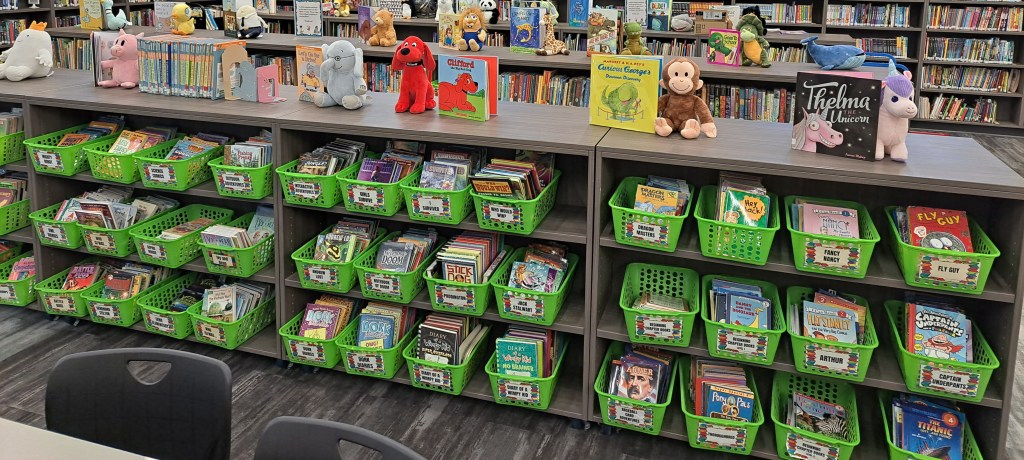
When I set up our new library 7 years ago I purchased baskets for all of the elementary series books. There are sooooo many series books and they take up valuable real estate on the shelves. Putting the series books in baskets was a game changer for our library.

Putting them in baskets means that all of the series books are easy for students to find and easy for me to shelve. The bulk of my books, aside from graphic novels, that are checked out by 1st through 4th come from these baskets. Students find a book they like and then they run with it and finish the series. When books are returned I just walk around and drop them in the correct basket. I don’t worry about putting them in order within the basket during the school year. At the end of the year, if I have time, I go through and arrange them in order but to be honest being out of order within the basket does not seem to hinder students in finding their desired read.

What about the cost? I had no budget when I set up our brand new library 7 years ago. I went to Dollar Tree and found these green baskets that matched the color decor fairly well. I wondered how they would hold up but I have not had to replace one basket in 7 years so I would say they were worth the dollar. There are lots of options out there for baskets that would work for your library.

Graphic Novel Section

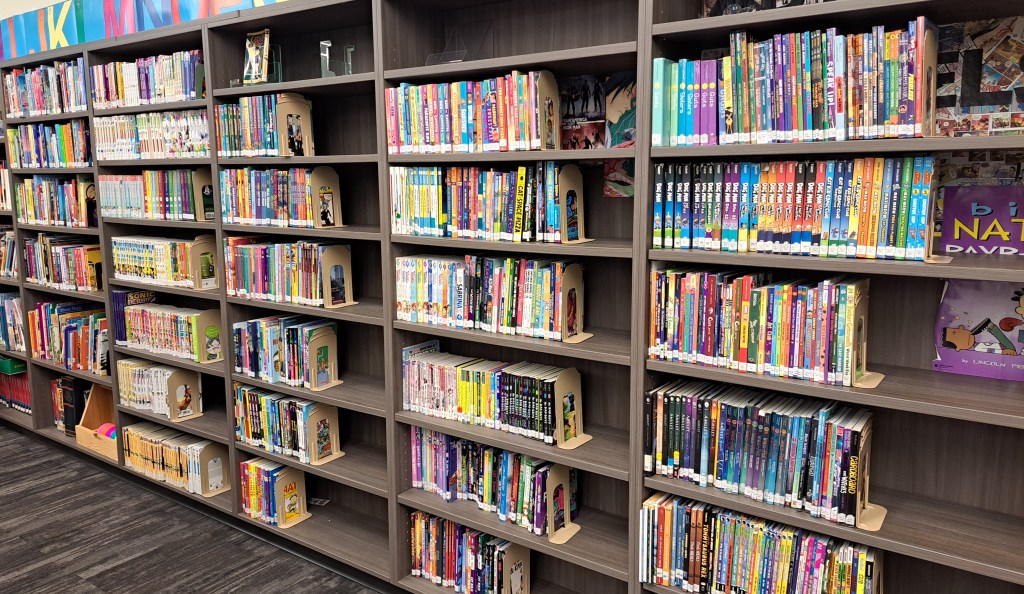
The busiest section of my library is the graphic novel section. Student’s love these books so making them easy to access was key. I moved them out of the nonfiction section and created a section of shelving just for the graphic novels. When I first set it up I had 5 sparsely filled shelves. Fast forward to today and I have 36 shelves of graphic novels. I just had to move things around this week to free up space so the shelves weren’t packed so tightly. I keep series books together within this section and…total transparency here… the rest are just put on the shelves in any order. They go in and out so quickly I don’t worry about alphabetical order. When shelving I am able to grab the graphic novels and go right to this section to put them away. Again, easy for students to find the graphic novel section and easy for me to shelve.

Finding the Time

I have found that shelving books is much like doing laundry. If you take the clothes out of the dryer and throw them on the sofa or in a spare room to “fold later”. They can pile up and become an overwhelming task. But, if you fold each load right as it comes out of the dryer it only takes a few minutes. For me, it is the same principle with shelving books in the library. When students come in they put their books on the blue book cart I use for library returns. After we read a story and they start their lesson or centers I go and scan the books that were returned. I then call them over 2 at a time to check out. While they are checking out I am walking through the stacks putting books away. With the systems I spoke of above it takes no time at all to put them back on the shelves. I have all the books from each class put away by the end of that class. If something happens, and I get busy I might end up with a few at the end of the day but I can quickly get those put away after my last class before heading home.

Now, that being said my book return cart is empty each day but that by no means is saying I have everything on my library list done. Back in my office I have an overflowing cart and stacks of books waiting to be processed and put on the shelves. But….we will leave that for another blog post. Happy shelving friends!!

What have you done in your library to make shelving easier? Any super tips you would like to share?

How to Play Kaboom! a Library Centers Game

When it comes to teaching elementary library classes I try to keep it fun and educational. One of the ways I do this is by offering library centers activities for students to use after a lesson or on specific days. Students want the fun aspect of library centers and my admin wants me to make sure that it is educational…the solution to both is using games like Kaboom!.

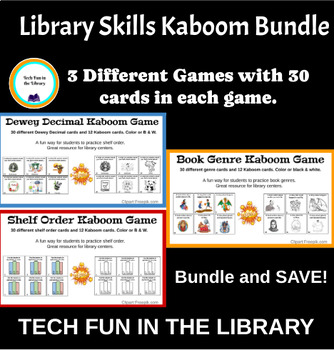
Kaboom! is one of my student’s favorite library centers activities. It can be used to practice book genres, shelf order, and the Dewey Decimal System. When it comes to reviewing or practicing these skills Kaboom! is the answer!

How to Play Kaboom!

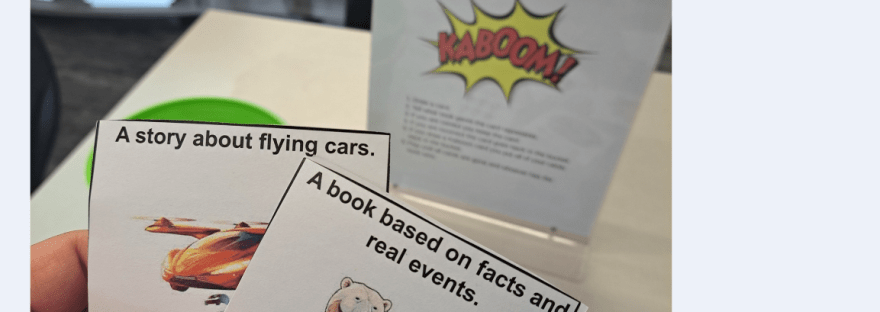
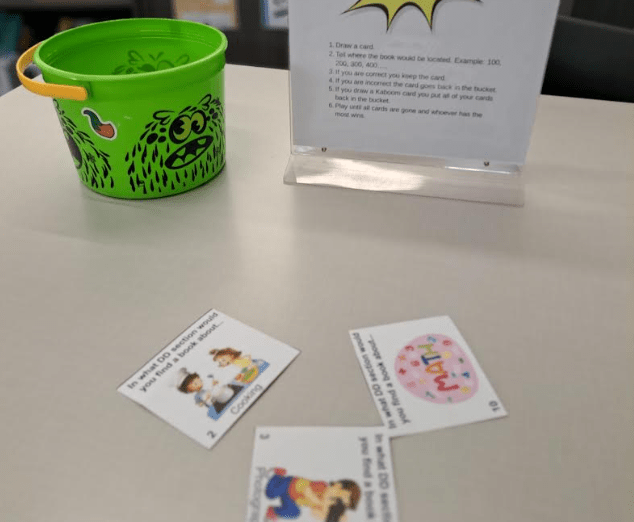
Extra perk…Kaboom! is a very simple library centers activity. To set up, all you need is a set of Kaboom! cards and a bucket or some type of vessel to put the cards in so students can’t see them when drawing a card.

 Let’s use Book Genre Kaboom! for the sake of instruction.

  • Students find their place at the table.
  • One at a time, students pull a card out of the bucket. 
  • The student drawing will read the book genre card and then tell the group what genre it is describing.
  • If the student gets the correct answer, they keep the card. If not, they put the card back in the bucket. 
  • The game continues as students take turns playing.
  • If a student gets a Kaboom card, that student puts ALL of their cards back into the bucket. 
  • The student with the most cards at the end of time is the winner.
  • I have one “expert” at the table who has the answer key and can judge whether the students have given the correct answer. The “expert” can rotate in and then someone else will become the “expert”.

As you can see, this game can be done with any concept, just switch book genre with one of the other library related Kaboom cards.

Secret fact about the game…IT NEVER ENDS. Eventually, somebody gets a Kaboom! card which means they have to put their cards back in the bucket thus adding to the cards in the bucket over and over again. For library teachers this means students are engaged and learning the full 10 to 15 minutes of the library centers rotation.

Shop for your copy of Kaboom! here.