A blog for school librarians, media specialists, and teachers. Find ideas for lessons, library centers, and books to read with students to support reading.
One of my favorite ways to kick off the school year in the library is with a good old-fashioned game of “Would You Rather”—library-style! It’s a simple, fun activity that helps me get to know the kids and gets them learning a little bit about each other too. Plus, it gets them moving, which is always a win!
I use a Google Slides version of the game that I project on the whiteboard. Each slide has a fun, library-themed question with two choices (A or B), and students move to the side of the room that matches their answer. Example: “Would you rather read books that make you laugh or books that make you scared?” Boom—movement, laughter, and instant conversation starters.
As a library teacher, I only see students twice a week, so I don’t get the same daily time with them that their classroom teachers do. That’s why I try to be intentional about relationship-building right from the start. This game gives me a peek into their personalities and interests in a low-pressure way. And honestly, it’s just fun to see what they pick!
It’s also great for helping students learn about their classmates. They get to see who shares their love of fantasy books or who’s also into listening to audiobooks instead of reading print. It’s quick, interactive, and gets us all smiling and talking—exactly how I want the year to start.
If you’re looking for a simple way to connect with students and build community in your library space, give it a try. The Google Slides version I use is available in my TPT store if you want to grab it and use it with your own classes. You might just learn who would rather read a book that smells like cookies or read a book that makes noises when you turn the page—and that’s important stuff to know.
The first week back in the library is always exciting, and this year will be no different! We will spend the first visit talking about library rules, book care, and how to be respectful and responsible with our library materials. We will also go over basic classroom rules focusing on being respectful, responsible, and safe. It’s so important to set the stage for a great year of reading, and that all starts with knowing the basics.
For each grade, we will read a different book related to library skills and book care. I read a different book to each grade level so that they are not getting the same books year after year. With the younger kids we will read about how to treat books gently, and older grades discussed things like where books live in the library and how to find what they need. After reading, we always have a great discussion about the key points from the book, like why it’s important to keep our books in good shape and return them on time.
Then comes the best part: the first checkout of the year! I love that everyone gets to check out books on day one—yes, even the Kindergarten students! Some like to make them wait or limit them to books they keep in class but I let them check out and take home. These young readers are just as excited to take books home as the older kids, and in fact, they are often the best at bringing them back because parents seem to be more involved and on top of returning weekly.
The first day is always full of energy, excitement, and a lot of book love. It’s a great way to kick off a year of reading, learning, and growing in the library! Looking forward to another fun and productive year ahead.
I love having library centers available for students to use after our read aloud or lesson. Library centers can provide another opportunity for students to practice library skills, writing, reading comprehension, vocabulary development, and much more under the disguise of playing games.
I have talked about Shark Bite! card games to practice book genres in another post so if you are interested feel free to check that one out. This time I wanted to share some fun matching games that are very popular with my students.
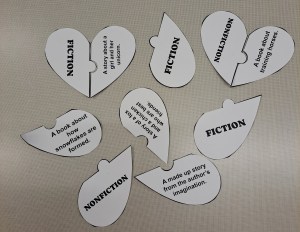
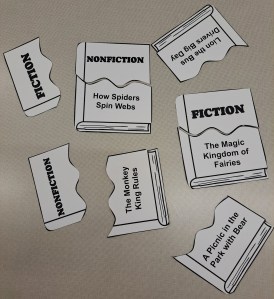
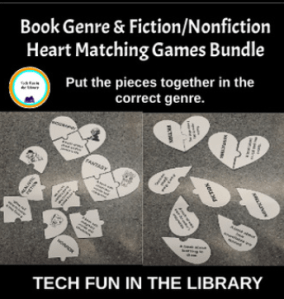
Book Genre Puzzle Matching Game
For this library center you will need to create some type of small puzzles that have book genre name, definition, and a picture to represent the genre if possible. Cut them into puzzle type pieces for students to spread out and then put back together matching the definitions with the genres. My students like to compete to see who can match the most. They also can be played individually with the student just trying to match all the correct genres to create the puzzles.
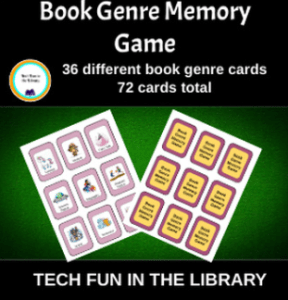
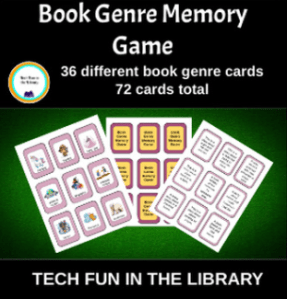
Book Genre Memory Matching Game
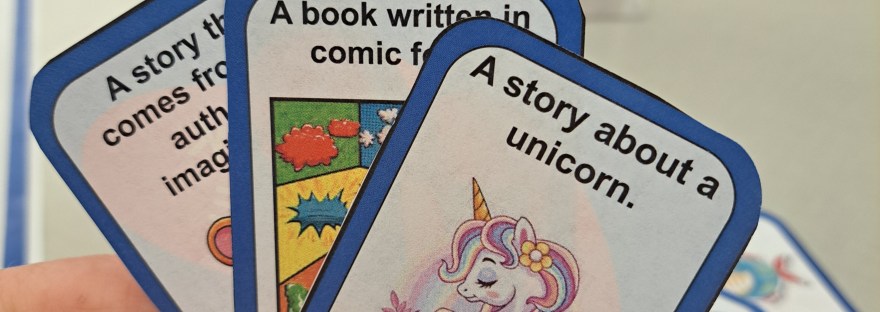
This one is great for students who love to play the memory game. Create cards with a picture representing the genre on one and the definition of the genre on another. These will be the matching cards students will try to match. Students will turn the cards face down on the table and then take turns trying to find the matching cards. Once all of the cards have been matched the one with the most matches wins.
Both of these activities are a fun way for students to practice book genres. Providing many options for library cents will help keep students from becoming bored which can then lead to behavior issues or disruptions. I
If you would like some premade matching activities you can find them on my TPT page.
Are your library centers starting to get a bit stagnant? Looking for new ideas on how to make centers fun and educational? Well, don’t worry, I have you covered. Time to add another fun game to your bag of tricks with Shark Bite! This is a perfect way for students to practice library skills in centers while having fun.
Shark Bite! is a fun card game that is perfect for elementary library centers. The game is similar to Kaboom! but with some more intense action cards to add to the fun. The goal is to get as many cards as possible by naming the book genre of each but some of the cards work for or against the students. If they pull an Octopus card they have to put a card back, an Angler Fish card they switch hands with another player, and a SHARK BITE card means they have to put all of their cards back in the bucket/pile. The library breaks out is excitement when they pull these ocean animal cards and have to give up their cards or switch hands.
How to Play Shark Bite
Print out the cards ( I like to use card stock and laminate to make them last) and put them into a bucket or pile.
Player draws a card, reads the card, and then chooses which genre that book or story would be placed.
If player gets it right they keep their card. If they get it wrong the card is placed back in the bucket or pile.
If a player draws a card with one of the ocean animals they have to follow the instructions for that animal.
The game continues until all of the cards are gone.
The student with the most cards at the end is the winner.
I have one student act as “Expert” to hold the answer key and make sure everyone is getting the correct book genre.
As you can see, this game can be done with any concept, just switch book genre with one of the other library related Shark Bite! cards.
Secret fact about the game…IT NEVER ENDS. Eventually, somebody gets a Shark Bite! card which means they have to put their cards back in the bucket thus adding to the cards in the bucket over and over again. For library teachers this means students are engaged and learning the full 10 to 15 minutes of the library centers rotation.
Aaahhh….that 5:00 am alarm. Yep, it was set and went off first thing this morning. Time to get into the routine of waking up early and heading to work. Back to reality.
If you are wondering what to do this first week back, you are not alone. I saw a reel last night of a teacher saying he had no idea what he was teaching today. He couldn’t even remember where they left off before break. Sound familiar? Yeah, me too.
This week in my library we will be doing a lot of reviewing library expectations and procedures. It has been a few weeks since we have all been together and let’s be honest…things got a bit lax right before break….so time for a refresher. Like us, kids have turned off their school brains over break and many need these reminders to get back on track with behaviors in class, thus going over expectations and procedures is always a good idea.
The other thing I like to do is ease back into things before starting new concepts or lessons. Our library will be doing Caldecott and Newbery Award lessons this month which are fun but I am going to give them a day or two to get back into the routine of school before jumping into these activities.
Here are a few ideas on how to start back a bit more low key but still learning.
New Year’s Themed Read Alouds
This is always a fun way to start back the first day after winter break. I like to read different books with a New Year’s theme to students and then we talk about resolutions or goals they might have for the new year. One of my favorites is Squirrel’s New Year’s Resolution. Students enjoy the story and then can think of ideas on how they can help others each day and make a few resolutions for themselves just like Squirrel. Here is a great Google Slides Reading Companion to go with this book. I love these Google Slides Reading Companions because they take no prep on my part. I don’t have to crowd into the printer room trying to get my turn to make 60 copies of an activity. All I do is put it into the Google Classroom and make a copy for all students.
There are sooo many great winter themed read alouds it is hard to choose. One of my favorites is Blizzard by John Rocco. The illustrations are great, the story is great, the fold out pages are great…and right now many are dealing with huge snowfall so it is definitely timely. Another fun one for younger grades is Just One Flake by Travis Jonker. My students love this story and can definitely relate to trying to catch snowflakes on their tongues. Then you can switch it up and read The Snow Globe Family or Snow Globe Wishes both great winter read alouds. With so many great reads out there you can’t go wrong just grab some and enjoy!!
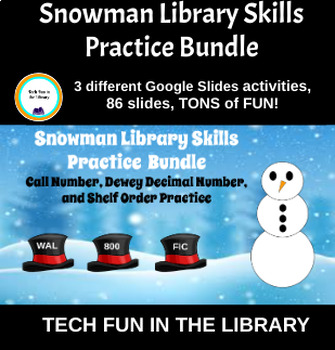
Choosing activities that go with the seasons are always a fun way for students to learn in the library. I like to add some digital activities to my centers along with games and writing activities. Some fun winter themed digital activities are these snowman library skills drag and drop activities. Students can practice their shelf order skills, call number skills, and Dewey Decimal skills with these fun winter themed Google Slides. Easy to share with students to use in centers or for something to do after check out.
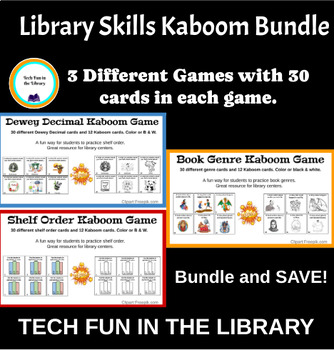
Kids love games and adding games that practice library skills is a win for any library centers activity. My students love Shark Bite! and Kaboom! both are great ways to practice library skills. Younger students enjoy playing the memory games that focus on book genres. Another popular one is UNO. Everyone loves to original game and this library themed one is a hit as well. These are just a few ideas to add fun and games to your library centers as you head back to school.
As hard as it is to go back after a break remember how excited some students are to be back at school and be back to the library. They are going to be excited to see you and eager to do whatever fun activities you have planned for them in the library. Enjoy the time you get with students, bring them more great stories and activities that will help them connect to reading and the library.
In an increasingly diverse world, one of the most important responsibilities of libraries is to make sure our collections reflect a wide range of voices, experiences, and perspectives. A diverse collection in a library is not merely a matter of quantity—it’s about ensuring that everyone can see themselves represented in the materials we have in our libraries. The content in libraries should reflect the richness of human experience, addressing issues of race, gender, class, sexuality, ability, and beyond. Here’s why a diverse collection is so important:
Promoting Inclusivity and Representation
Representation matters. When libraries feature diverse materials, they validate the experiences of all groups. This is especially crucial for young readers and members of underrepresented communities who might not see themselves reflected often in books. Diverse collections ensure that every patron, regardless of background, can find books that connect with their identity, experiences, and struggles.
For example, children who see characters from various cultures, backgrounds, and abilities in books are more likely to develop empathy and an understanding of people who are different from themselves.
Encouraging Critical Thinking and Empathy
Our library collections should serve as a mirror to the world. Having library materials that present different viewpoints, backgrounds, and beliefs, will help encourage students to think critically about the world around them. Exposing students to diverse perspectives helps them to develop a deeper understanding of the world and people around them.
Fostering a Sense of Belonging
Libraries should be safe spaces where students can explore new ideas, learn, or even just find comfort in a place they feel safe and seen. When library collections are diverse, they create an environment where everyone feels seen and heard. For members of underrepresented communities, knowing that the library acknowledges their histories, experiences, and identities fosters a sense of belonging and respect.
These are just a few of the reasons we should be making sure that our collections are diverse to meet the needs of all our students. It is never too early to get started on making your collection as diverse as possible. A diverse library collection is not just about offering more books—it’s about building a more inclusive, understanding, and just world for everyone.
Here we are almost half way through the current school year and book returns are on the rise. While this is great it does pose a problem….shelving. One of the big issues I hear from school librarians is that there is very little time to shelve books. What do you do about book returns? How do you get them back on the shelves in a timely manner? As a librarian of a K-12 library with no aide, I understand the difficulties of shelving books while conducting back to back classes. I have made a few adjustments in my library to make it easier to go home with an empty book cart every day.
Baskets for Series Books
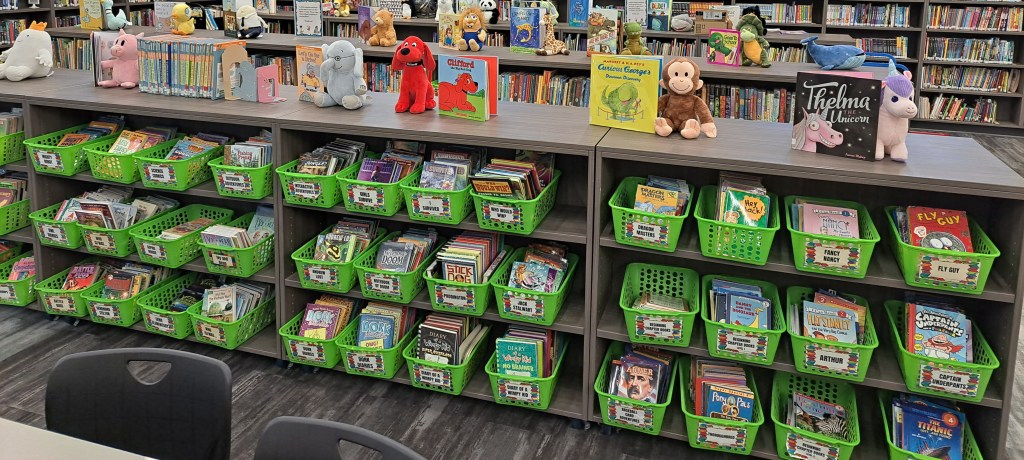
When I set up our new library 7 years ago I purchased baskets for all of the elementary series books. There are sooooo many series books and they take up valuable real estate on the shelves. Putting the series books in baskets was a game changer for our library.
Putting them in baskets means that all of the series books are easy for students to find and easy for me to shelve. The bulk of my books, aside from graphic novels, that are checked out by 1st through 4th come from these baskets. Students find a book they like and then they run with it and finish the series. When books are returned I just walk around and drop them in the correct basket. I don’t worry about putting them in order within the basket during the school year. At the end of the year, if I have time, I go through and arrange them in order but to be honest being out of order within the basket does not seem to hinder students in finding their desired read.
What about the cost? I had no budget when I set up our brand new library 7 years ago. I went to Dollar Tree and found these green baskets that matched the color decor fairly well. I wondered how they would hold up but I have not had to replace one basket in 7 years so I would say they were worth the dollar. There are lots of options out there for baskets that would work for your library.
Graphic Novel Section
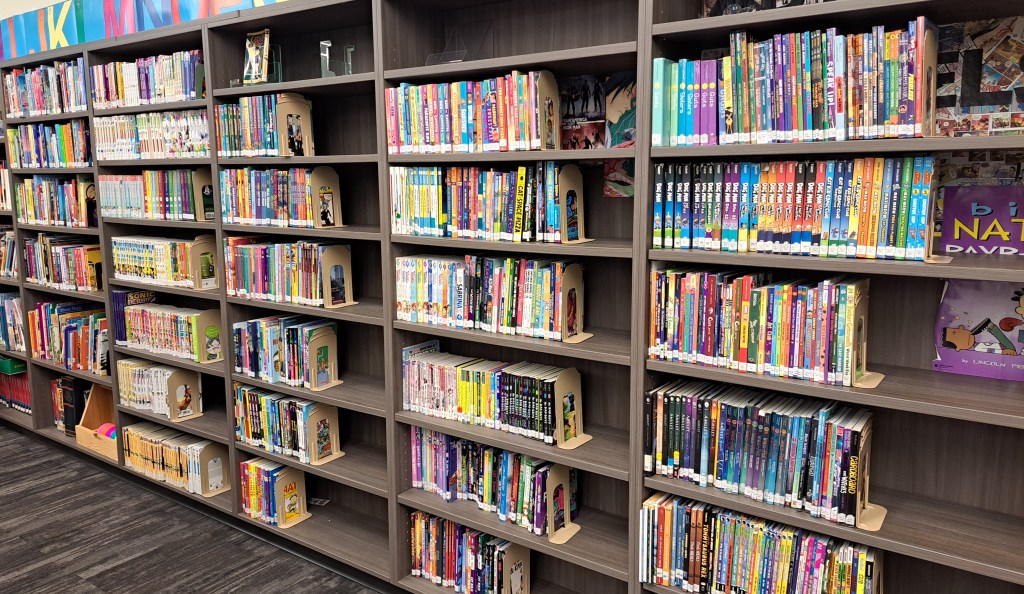
The busiest section of my library is the graphic novel section. Student’s love these books so making them easy to access was key. I moved them out of the nonfiction section and created a section of shelving just for the graphic novels. When I first set it up I had 5 sparsely filled shelves. Fast forward to today and I have 36 shelves of graphic novels. I just had to move things around this week to free up space so the shelves weren’t packed so tightly. I keep series books together within this section and…total transparency here… the rest are just put on the shelves in any order. They go in and out so quickly I don’t worry about alphabetical order. When shelving I am able to grab the graphic novels and go right to this section to put them away. Again, easy for students to find the graphic novel section and easy for me to shelve.
Finding the Time
I have found that shelving books is much like doing laundry. If you take the clothes out of the dryer and throw them on the sofa or in a spare room to “fold later”. They can pile up and become an overwhelming task. But, if you fold each load right as it comes out of the dryer it only takes a few minutes. For me, it is the same principle with shelving books in the library. When students come in they put their books on the blue book cart I use for library returns. After we read a story and they start their lesson or centers I go and scan the books that were returned. I then call them over 2 at a time to check out. While they are checking out I am walking through the stacks putting books away. With the systems I spoke of above it takes no time at all to put them back on the shelves. I have all the books from each class put away by the end of that class. If something happens, and I get busy I might end up with a few at the end of the day but I can quickly get those put away after my last class before heading home.
Now, that being said my book return cart is empty each day but that by no means is saying I have everything on my library list done. Back in my office I have an overflowing cart and stacks of books waiting to be processed and put on the shelves. But….we will leave that for another blog post. Happy shelving friends!!
What have you done in your library to make shelving easier? Any super tips you would like to share?