If you had told me at the beginning of this school year that a blended 7th and 8th-grade library class would become one of my favorite parts of my week, I might not have believed you.
Coming from an elementary background, the thought of staring down a classroom of junior high students for 90-minute blocks, two and three times a week, felt a little intimidating. How was I going to keep them engaged? How do you fill that much time without losing them to the abyss of middle school eye-rolls?
But as the year wrapped up, I looked back and realized it was an incredible success. Having those long blocks actually allowed us to dive into deep, meaningful research activities that you just can’t squeeze into a standard 45-minute elementary rotation.
My secret weapon? Mixing it up every single week. If you are starting a new junior high library class next year, here is a breakdown of some of the units, resources, and activities that kept my students engaged, talking, and learning.
Media Literacy & Big Discussions
Junior high students are drowning in digital media, but they don’t always know how to navigate it. We dived deep into digital citizenship and internet safety using Above the Noise (via KQED/PBS).
- How I used it: These videos are sharp, fast-paced, and highly relevant to teens. I paired them with video guides for the students to fill out as they watched to keep them focused. I also used this as an opportunity to practice Google Slides and Canva. Students summarized what they learned by creating presentations in one of these.
- The result: This completely unlocked the room. It led to some of the most insightful, honest discussions and discoveries about social media algorithms, fake news, and digital footprints.
Collaborative Research with a Retro Twist
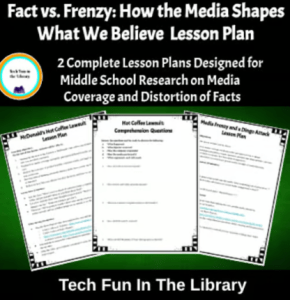
To teach research skills without hearing the groaning and complaining, I used videos from Retro Report (an incredible resource that connects history to current events).
- How I used it: We used their investigative videos to look at topics like invasive species and media frenzies. Students worked in groups to unpack the history, analyze the media’s role, and conduct their own deep-dive research based on the prompts.
Creative Writing & Author Deep Dives
With 90 minutes on the clock, we had the luxury of slowing down for multi-step creative projects. Two of our absolute favorite writing and research units were:
- “Library After Dark” Creative Writing: I challenged the students to write a creative story about what happens in our library when the lights go out. Giving them the freedom to write ghost stories, fantasy adventures, or mysteries set in their actual school building sparked incredible creativity.
- Author Deep Dives: Instead of a generic biography report, students chose an author and did a comprehensive research deep dive. They investigated the author’s background, their writing process, what inspired their most famous works, and how their style evolved over time. It was a fantastic way to blend database research with literary appreciation.
The Middle School Mock Caldecott
Think picture books are just for the younger grades? Think again. One of our major highlights was running a Mock Caldecott unit with my 7th and 8th graders.
- How I used it: I chose books that were recommended on different Mock Caldecott blogs and sites, plus some of my own personal favorites. Then, we looked at the actual evaluation criteria used by the real-world ALA judges to grade the art, media, and storytelling. Finally, the students cast their official votes to see if they could successfully predict the real winners.
- The result: The kids took this so seriously. It was a brilliant way to practice critical evaluation skills and analyze visual storytelling at a higher level.
Rethinking “Book Time” for Big Kids
You might think 8th graders are “too old” for certain library books, but I found that changing how we interacted with the collection changed everything. Some of the fun activities we did with books were:
- Wordless Picture Books: We used these for visual literacy, storytelling, and sequencing activities. It forced them to slow down and look at detail, context clues, and subtext.
- Ripley’s Believe It or Not Books: Never underestimate the power of weird trivia. These were fantastic for an end of the year news article writing assignment. They had to pick a bizarre event and then write a realistic sounding news article.
- Fractured Fairy Tales: We spent time analyzing traditional fairy tales and breaking down how they are built. Then, I set the students loose to write and create their very own fractured versions. They had a blast spinning old classics on their heads.
- Studying Point of View: I pulled various picture books specifically to study point of view. Because they are short and direct, they were a fast, visual, and really effective way to show students how a story changes drastically depending on who is telling it.
Keeping Catalog Skills Sharp
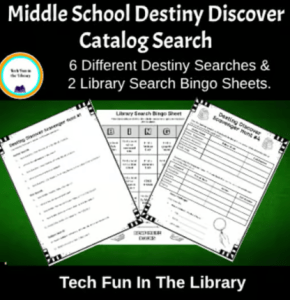
- Destiny Scavenger Hunts: Destiny Scavenger Hunts: To make sure they didn’t lose their practical library skills amidst all the big projects, we periodically did Destiny Scavenger Hunts. It was a great way to keep them familiar with using the library catalog system so they can find the books they need.
Year One: In the Books!
Overall, it was a great first year with this course. I was definitely worried at the beginning, but it quickly became one of my absolute favorite classes. It turns out that when you give 7th and 8th graders the right mix of new activities, videos, and creative choices, a 90-minute block actually flies by. I’m so glad I got to try these new ideas with them, and I’m already looking forward to adding to the class year after year.
Fellow librarians: Do you teach a junior high or middle school block? What are your go-to resources for media literacy or creative writing? Let’s swap ideas in the comments!
Click the images below to find these activities on my TPT page.