A blog for school librarians, media specialists, and teachers. Find ideas for lessons, library centers, and books to read with students to support reading.
Did you know October is National Squirrel Awareness Month? We celebrated in the library this week with a super fun read-aloud — Girl Versus Squirrel by Hayley Barrett. The students LOVED it! Lots of giggles and big reactions, especially when we followed it up with Mark Rober’s Squirrel Ninja Course video on YouTube. So much laughter!
When their teacher came to pick them up, they were all talking a mile a minute, excited to share what they learned about squirrels. The teacher smiled and said, “I love seeing so much excitement about reading.” Big win!
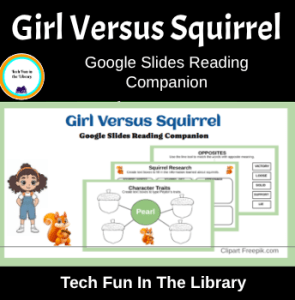
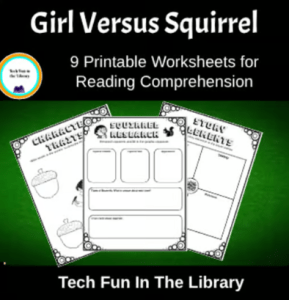
During their next visit, students jumped right into the Google Slides Reading Companion I made to go along with the book. They practiced story elements, sequencing, syllable counting, opposite words, and even did a mini research activity on squirrels. For anyone who prefers to keep screens off during library time, I also made a printable version.
It was such a fun way to mix reading, learning, and a little squirrel silliness.
This little holiday is overlooked by many. I know in my school, until I started sharing books about Groundhog Day, most my young readers had never even heard of it. Teachers have so much to squeeze into their day they don’t have time to add this little holiday into the mix. Thus, sharing books and “celebrating” in the library is a great way to expose students to this quirky little holiday that is sometimes overlooked.
Groundhog Day Read Alouds
Each year I have a different book that I read to each grade. Reading picture books about Groundhog Day to students in the library is a delightful way to get them excited about the season’s big question—will we have an early spring or six more weeks of winter? Depending on where February 2nd falls in the we will celebrate the day of or the day before and other years we celebrate the day after.
Here are some books I like to share with my students:
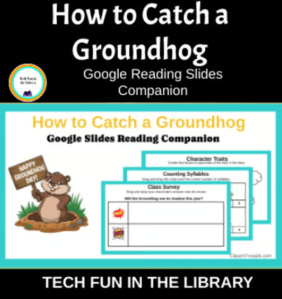
Kindergarten: How to Catch a Groundhog
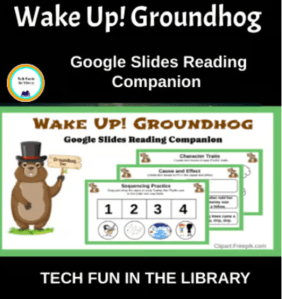
1st Grade: Wake Up Groundhog
2nd Grade: Groundhog’s Day Off
3rd Grade: Groundhog’s Dilemma
4th Grade: Groundhog Gets a Say
5th Grade: Groundhog Gets it Wrong
6th Grade: Phil’s Big Day
After we read the story I like to share a video about Groundhog Day so they understand the background behind it and why it is celebrated. Here are a couple good ones I found on Youtube that I like to share with students.
Lesson Finale
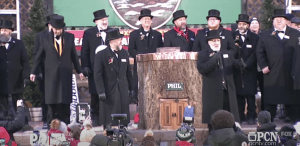
After reading the picture book and watching the short video it is time to actually watch the real Phil make his predictions. It is fun to do a quick class vote to see who wants 6 more weeks of winter and who wants an early spring. This year my classes had an overwhelming desire for 6 more weeks of winter because we have not had any snow yet and we are all still hopeful.
If I am doing this lesson prior to Groundhog Day I show the video from the previous year to let them see how it works. Once February 2nd has arrived and the new prediction is made I take time in class to show them the current results. This year Groundhog Day falls on Sunday February 2nd so we will do the lesson on Monday February 3rd and Tuesday February 4th. We will then be able to watch the most recent prediction on the same day we read the stories. I always just go to Youtube and look for “Groundhog Phil Prediction Pennsylvania” to find the most recent one.
Here is the one from this year that we watched.
There you have it, celebrating Groundhog Day in the library with picture books and short video clips is a fun and engaging way to introduce your students to this quirky tradition. So, whether you’re reading a fun picture book, watching a short video, or doing both Groundhog Day in the library is a fantastic way to embrace the season and spark children’s imaginations.
Looking for some fun activities to add to your lesson?
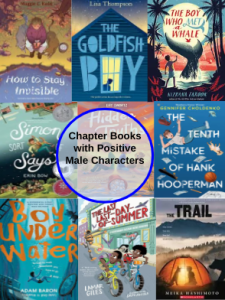
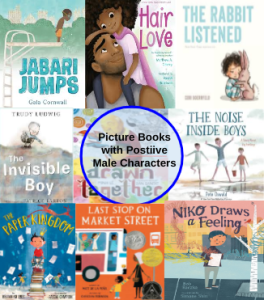
As we choose picture and chapter books to share with our students via read alouds or on our shelves, it is important to remember that they can be powerful tools to help shape young minds. In this mission to provide books that serve as windows and doors to all of our readers it is imperative we bring books with strong male protagonists to our young readers.
Positive Masculinity Representation
Providing books that have male characters who display empathy, kindness, respect, and emotional intelligence shows boys that it’s okay to show vulnerability and caring. These qualities can help bring a more rounded view of masculinity, possibly countering stereotypes that may limit emotional expression or compassion in boys.
Diverse Role Models
When boys encounter a variety of male characters with different experiences, personalities, and backgrounds, they learn that there is no single way to “be a man.” These characters can range from adventurous heroes to thoughtful leaders to young men struggling with mental or physical illnesses all broadening their understanding of who they can be.
Problem-Solving and Resilience
Male characters who overcome challenges, whether through intelligence, perseverance, or teamwork, help teach boys resilience. Seeing male characters work through difficult situations fosters a growth mindset and a belief in their own ability to solve problems.
Encouraging Emotional Expression
Books with male characters who express and process their feelings in healthy ways help boys understand that emotions are natural and should be acknowledged, not hidden or pushed aside.
Supporting Positive Relationships
Male characters in picture and chapter books can model positive relationships, whether with family, friends, or peers. Boys learn about friendship and the importance of mutual respect in these interactions.
Cultural and Social Awareness
Male characters in diverse settings and stories provide important lessons in cultural sensitivity and social awareness. They can show boys how to interact with people from different backgrounds, teaching acceptance and empathy from a young age.
Promoting Gender Equality
By featuring male characters who support and respect female characters, picture books can also model gender equality. Boys learn early on that valuing others and working together is important, regardless of gender.
In short, male characters in picture and chapter books can be essential role models who teach young boys about emotional health, problem-solving, empathy, resilience, and equality. The lessons they impart can significantly shape boys’ development into well-rounded, compassionate, and self-assured individuals.
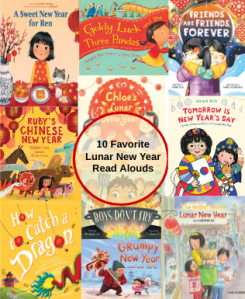
Lunar New Year, also known as the Spring Festival, is a time of celebration, family gatherings, and cultural reflection. For many families, it’s not just about the festivities; it’s also about passing down traditions and values to the next generation. One of the most enjoyable and meaningful ways to help your students learn about the culture importance of Lunar New Year is by reading picture books that highlight the stories, customs, and history of this holiday.
A Sweet New Year for Ren by Michelle Sterling: A picture book about a young girl named Ren who eagerly anticipates Lunar New Year and the family traditions and festivities that come with it.
Goldy Luck and the Three Pandas by Natasha Yim: A girl named Goldy Luck is not very lucky and ends up causing chaos in her neighbor’s home. This is a fractured fairy tale replacing Goldilocks with Goldy and the Three Bears with Pandas.
Friends are Friends Forever by Dane Liu: Join Dandan, a young girl who is moving from China to America, and her close friend Yueyue, as they navigate the emotions of saying goodbye while cherishing their shared tradition of making paper snowflake decorations on Lunar New Year’s Eve.
Ruby’s Chinese New Year by Vickie Lee: Tells the story of a young girl named Ruby who wants to deliver a special card to her grandmother for Chinese New Year, but her grandmother can’t travel so Ruby decides to journey to her instead.
Chloe’s Lunar New Year by Lily LaMotte and Michelle Lee: Join Chloe as her family prepares for the Lunar New Year.
Tomorrow is New Year’s Day by Aram Kim: Mina shares the traditions of Seollal (Korean Lunar New Year) with her classmates at school while trying to include her reluctant younger brother.
Boys Don’t Fry by Kimberly Lee: Jin wants to help his Malaysian family prepare for the Lunar New Year feast. But, he is discouraged because “boys don’t fry” or cook. Jin’s grandmother recognizes his passion and allows him to join in the meal prep traditions.
How to Catch a dragon by Adam Wallace: This book follows a group of kids during Chinese New Year celebrations as they try to catch a mischievous dragon that is roaming through their town.
Grumpy New Year by Katrina Moore: A young girl named Daisy wants to visit her Grandpa in China to celebrate Lunar New Year. In her excitement she becomes too tired to sleep and becomes grumpy.
The Night Before Lunar New Year by Natasha Wing and Lingfeng Ho: A picture book about a young girl who is excited for Lunar New Year but is nervous about the loud noises at the parade.
My first graders come to the library twice a week. If you know this age group you know that there are times they can get a little squirmy and bored if you don’t have something to keep them engaged the whole class period. This week we worked on one of my Google Slides Reading Companions activities. It was the perfect way for students to get back into the swing of library after an extended break.
What are Google Slides Reading Companions?
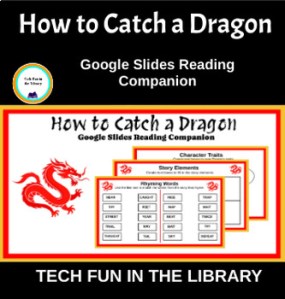
These are lessons I have created to bring both tech and library together. I not only teach library but I also teach technology. When I first started doing both 8 years ago I had no idea how to get enough time to improve skills in both areas. I decided to create some lessons that would give them the library skills and books while at the same time working on basic tech skills. The Google Slides Reading Companion was born!
No Snow Yet…But We Are Hopeful
As I have said in other blogs winter themed read aloud are perfect for this time of year. I chose to do Just One Flake this week. We read the story and then talked about times that they tried to catch snowflakes on their tongues. Almost all admitted they have tried to do this when it snows. After the story I used the projector to display the slides and show students what they needed to do for each slide. Then students logged onto their Chromebooks and began the lesson.
Tech Skills Practiced
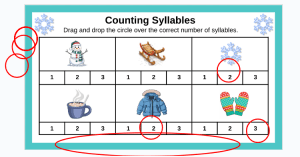
At this age I know mastering the track pad is key to being successful on the Chromebooks. This lesson has a lot of drag and drop activities to give students the practice they need manipulating the trackpad. Is it always easy? No, sometimes they get frustrated when they can’t get the object to move or when they stretch out the circle they are trying to drag and drop. But, as with anything, practice makes perfect. I remind them that the more they practice the easier it will become. Below is an example of one student’s work dragging and dropping circles over the correct number for syllables. As you can see they did stretch out the circles.
Movement During the Lesson
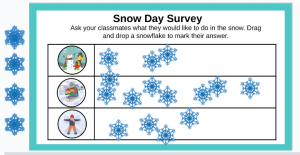
I love that this lesson adds a chance for movement during class. At the end of the slides there is a survey slide that students need to ask their classmates about a favorite event on a snow day. It is so fun to watch them go around asking their classmates what they like best and then dragging and dropping the snowflake to the appropriate box. They love getting to move around and talk while still being engaged in the lesson. Now that is a win for everyone!
A Great Way to Learn
Overall, it has been a great few days working with my first graders. Students have been engaged and having fun which makes them happy. Students have been learning new skills and practicing old skills which makes me happy. I didn’t have to make a stack of copies for assignments, I didn’t have to keep track of unfinished work until the next time they came, and I was able to watch them grow in their computer skills. If you are looking for a fun activity to use with your students Google Reading Slides Companions are a great way to add tech to your lessons.
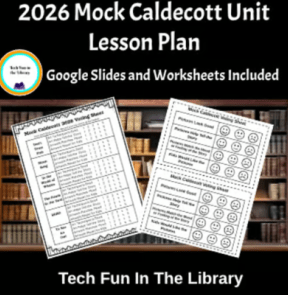
January is right around the corner and that means it is time for our “Mock” Caldecott. This is one of my favorite units because it gets kids reading and evaluating books. January can be a bit rough as we come back from an extended winter break and the fun of all the holiday activities is behind us. Adding this unit has been a great way to keep students engaged and learning in the library.
Preparing for the Unit
Getting ready for this unit does take a bit of preparation on your part as you need to decide what books you will have students reading and evaluating for the unit. I go on the Internet and search up Mock Caldecott books that others have posted and are using. There are also Mock Caldecott groups on social media that can be very helpful. I try to find ones that are mentioned on numerous sites. No one knows for sure what books are being scored by the actual Caldecott judges but so far I have always ended up with winning books in the list of books I provided for my students to judge.
Where Do You Get the Books?
Of course, I don’t always have all of the books that I put on my list. I work in a small district so purchasing that many new books for one unit is not feasible. What do I do? I go to my public library and check out the ones I don’t already have in my library. I make sure that I remind the students over and over that the books we are looking at do not belong to our school so we need to be extra careful when reading them. I have never had an issue with damaged books. If using the public library isn’t an option you can still do the unit by just picking books from your library that you feel have great illustrations and would be good for student evaluations. It is the process of viewing books and illustrations that is important for this unit not necessarily the books themselves.
Time to Start
On the first day of the unit I pull as many Caldecott and Honor winners as I can from my collection and display them on the tray of the whiteboard. When students come in they notice the books and they start asking about them. I find this is a great way to introduce the unit because it has already captured their attention. I then ask them what the books have in common. There are lots of different answers that arise but each time one student does notice the Caldecott Medals on the front. Once they know this is what we will be learning about I start my Google Slides lesson giving background about the award. Yes, I do this year after year and my upper grade students have heard it before but they always forget so it doesn’t hurt to reteach.
Looking Closely at Picture Books
After that we dive into the books and get started. (Step by step lesson plans are included in my Mock Caldecott Unit Lesson) I choose to use 12 books each year and it takes us 2-3 weeks to get through them. I read the books to lower elementary then they vote. For upper elementary I have them read the books to themselves and vote. My students, even the reluctant readers, enjoy this unit because they are really evaluating the illustrations and the pressure to read is not there as it is in some other reading activities. As they are working on each book I love the conversations I am hearing about the books.
Overall, this unit is a great way for students to be exposed to new books and to take the time to evaluate the illustrations. I know my students enjoy this unit because each year when they come in and see the books on the whiteboard tray I hear, “Oh yay, we are picking the winners again!”